
Criminal Court Records in George County
A criminal court record in George County is the case file the clerk opens the moment a prosecutor files formal charges. The file grows as the case moves forward. It gathers the charging document, bond paperwork, the plea, every motion and order, the hearing dates, and the final judgment. For felonies and for misdemeanors heard at the higher level, Circuit Clerk Chad Welford keeps this file at 355 Cox Street in Lucedale. The clerk owns the court record, not the arresting officer. A jail booking sheet and a court case file are two separate documents. The booking and charge side lives on the George County arrest records and court charges page.
Criminal work in George County is split across more than one court. Circuit Court tries felonies, hears some misdemeanors, and takes criminal appeals from County Court. Justice Court handles misdemeanor charges, felony preliminary hearings, and many citations written by state and county officers. Lucedale Municipal Court deals with city police cases and ordinance violations. Each court keeps its own file. So the first task in any George County criminal case search is to learn which court heard the matter.
How to Search George County Criminal Court Records
George County does not publish one unified public website that searches every criminal case. The Chancery Clerk runs an online portal, but it covers land records and recorded instruments, not Circuit Court dockets. For criminal case files the reliable route is the clerk counter or phone line at the court that handled the case. Honest expectation setting matters here: plan to call or visit, not to click a single search box.
- Decide the level of the charge. A felony or a Circuit Court misdemeanor points to the Circuit Clerk; a county misdemeanor or traffic charge often points to Justice Court; a city ticket points to Lucedale Municipal Court.
- Contact the Circuit Clerk at 601-947-4881 for felony and Circuit Court files, or Justice Court clerk Angela Edwards at 601-947-4834 for misdemeanors and preliminary hearings.
- Give the clerk the defendant name and, if you have it, a case number or approximate filing date to narrow the file.
- Ask the clerk to confirm the charge, plea, disposition, and sentence shown in the docket, since older files may be paper only.
- Request a certified copy from the clerk when you need the record for a legal or official purpose.
Statewide and federal layers sit above the county. The Mississippi Department of Corrections runs a free statewide inmate search for people sentenced into state custody, which can confirm an outcome a county file points toward. Federal charges from George County route to the U.S. District Court for the Southern District of Mississippi and are searched through PACER, a separate system from any county clerk.
Stages of a George County Criminal Case
A criminal case moves through fixed stages, and each step leaves a mark in the court file. Reading the docket in order shows how the matter traveled from accusation to outcome. The same flow holds whether the case starts in Justice Court on a preliminary hearing or opens in Circuit Court on a grand jury indictment.
Case flow: Charges Filed › Arraignment › Pretrial / Motions › Plea or Trial › Disposition › Sentencing
| Stage | What Happens |
|---|---|
| Arraignment | The court reads the charges, the defendant enters a plea, and bond terms are set or reviewed. |
| Pretrial / Motions | Lawyers file motions, exchange discovery, and argue what evidence the trial can use; dates and orders are logged. |
| Plea or Trial | The case ends in a negotiated plea or goes to trial, where a judge or jury decides guilt. |
| Sentencing | After a conviction or plea, the judge orders the punishment, which the file records as the sentence. |
Note: A felony in George County usually passes through Justice Court for a preliminary hearing before a grand jury indictment moves it up to Circuit Court.
What a George County Criminal Court Record Shows
A Circuit Clerk criminal file is built from labeled fields, and learning them helps a reader pull meaning from a dense docket. The file commonly names the case, the parties, the charge, and the result, then tracks every action in between. Justice Court records carry similar fields plus a citation number and the agency that wrote the charge.
| Field | What It Shows |
|---|---|
| Case Number | The unique number the clerk assigns to track the file and all of its documents. |
| Defendant | The person charged, often with a date of birth or other identifier to avoid name mix-ups. |
| Charges | The offenses as filed, with statute citations and the level, such as felony or misdemeanor. |
| Plea | The defendant's formal answer, such as guilty, not guilty, or no contest. |
| Disposition | The outcome of each charge, such as convicted, dismissed, or acquitted. |
| Sentence | The punishment ordered after a conviction, including jail, fines, costs, and probation. |
Public copies leave out protected data. A clerk redacts Social Security numbers, financial account numbers, and details that identify a minor. Sealed and expunged matters do not appear at all in ordinary public access.
Charges vs. Convictions
Being charged is not the same as being convicted. A criminal court record can show charges that were later dropped, dismissed, or that ended in acquittal. A charge is only an accusation. A conviction is a proven or admitted result. Reading the disposition line, not the charge line, tells you what actually happened.
| Charge | Conviction | |
|---|---|---|
| Stage | Accusation | Verdict or plea |
| Burden of Proof | Probable cause | Beyond reasonable doubt |
| Who Decides | Prosecutor | Judge or jury |
| Public Record | Yes | Yes |
This gap matters for background checks and reputation. A person can carry a charge in the record that never became a conviction. For a closer look at how charges are filed, amended, and reduced, the George County court charge records page follows that path in detail.
Reading Dispositions and Sentences
The disposition is the short word or phrase that states how a charge ended. The sentence is the punishment that follows a conviction. Court files use legal shorthand, so a few key terms make the record readable. The definitions below come straight from the language George County courts use.
- Arraignment
- The hearing where charges are read and the defendant enters a plea.
- Plea
- The defendant's formal response, such as guilty or not guilty.
- Disposition
- The outcome of a criminal charge, such as convicted or dismissed.
- Nolo (No Contest)
- A plea that accepts the penalty without admitting guilt.
- Probation
- Supervised release ordered instead of or after time in jail or prison.
- Capias
- A court order to take a person into custody after a default in the case.
A sentence may stack several parts. The judge can order jail or prison time, a fine, court costs, restitution, and a term of probation in one order. The file lists each part and any condition attached. A line reading dismissed with prejudice means the charge is closed and generally cannot be refiled, while dismissed without prejudice leaves the door open to charge again.
Who Prosecutes George County Criminal Cases
The court clerk keeps the file, but a prosecutor decides what charges to bring. In George County that job is split by offense level. The Office of the District Attorney for the 19th Judicial District prosecutes every felony charged in the county, and its district attorney page sets out that role across Jackson, George, and Greene counties.
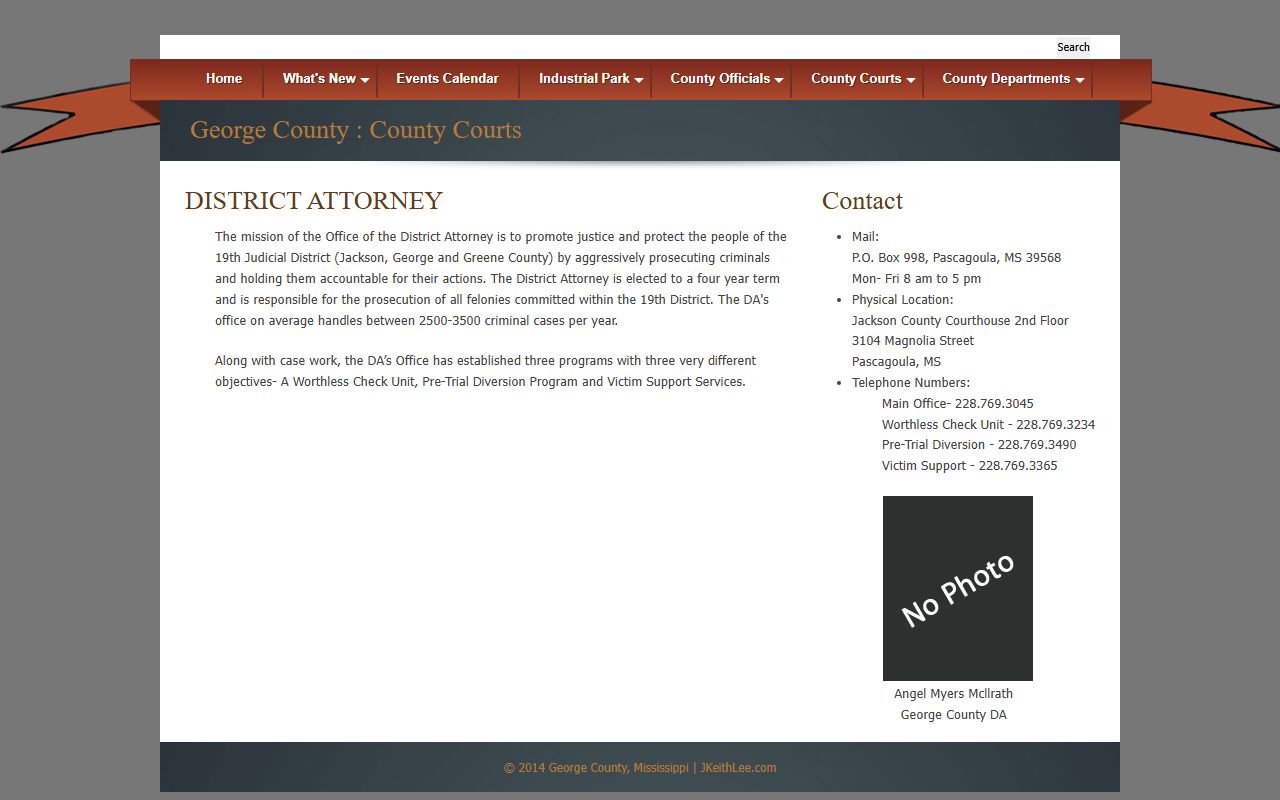
Because the DA controls felony charging decisions, the choices made there shape what later appears as charges and dispositions in the George County criminal court record. The office reports an average caseload of 2,500 to 3,500 criminal cases a year and runs a Pre-Trial Diversion Program, a Worthless Check Unit, and Victim Support Services. The DA sits outside the county seat, so felony charging records may route through a prosecutor based in Pascagoula.
District Attorney, 19th Judicial District
Jackson County Courthouse, 2nd Floor
3104 Magnolia Street, Pascagoula, MS
Main Office: 228-769-3045
Pre-Trial Diversion: 228-769-3490
Victim Support: 228-769-3365
Worthless Check Unit: 228-769-3234
Lower-level matters follow a different track. The county's County Prosecutor page describes the misdemeanor and preliminary-hearing work handled close to home in Lucedale.
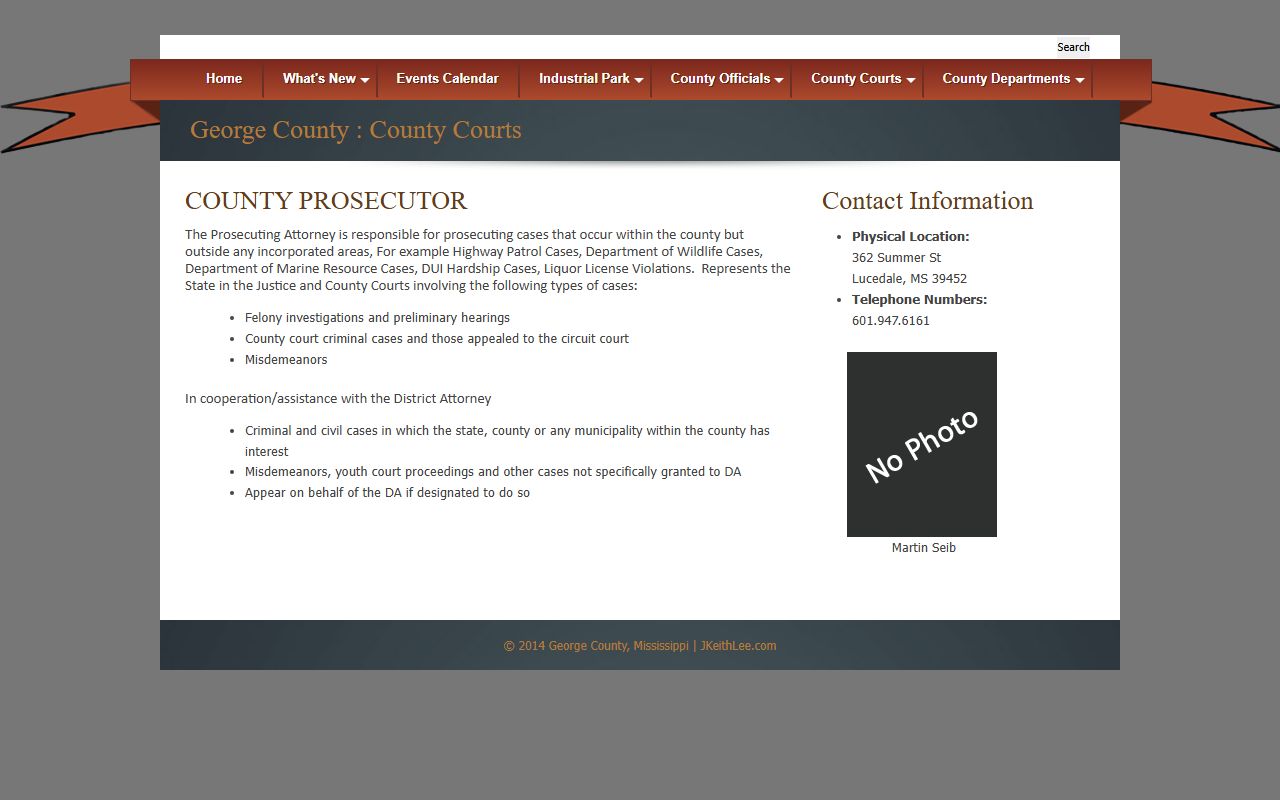
That split tells a record searcher where to look. The County Prosecutor represents the state in Justice and County Courts, handling misdemeanors, DUI hardship matters, liquor-license violations, and preliminary hearings on felonies before they advance. Misdemeanor case files tend to sit in Justice or County Court, while felony files move up to Circuit Court.
George County Prosecuting Attorney
362 Summer Street
Lucedale, MS 39452
Phone: 601-947-6161
Sealed vs. Expunged Records
Two different orders can pull a criminal record out of public view, and they are not the same. A sealed record still exists but is hidden from ordinary public access. An expunged record is treated as if it never happened. Mississippi's main expunction statute, Miss. Code Ann. § 99-19-71, covers several categories, including first-offender misdemeanors, certain felony convictions, and cases that were dismissed, dropped, or left without a disposition.
| Sealed | Expunged | |
|---|---|---|
| Visibility | Hidden from public | Treated as never existed |
| Law Enforcement | Limited access | Very limited access |
| Eligibility | Often youth or protected matters | Eligible misdemeanors and certain felonies under § 99-19-71 |
Expunction is a court process, not a counter request. A clerk cannot erase a record because someone asks.
- Identify the court that handled the charge, whether Justice Court, Municipal Court, County Court, or Circuit Court.
- Confirm the case fits a category under Miss. Code Ann. § 99-19-71, such as a dismissed case or an eligible first offense.
- File a petition to expunge in that same court, since the court of conviction or arrest holds the file.
- Confirm the filing fee with the clerk, since George County does not publish a set expunction fee.
- Wait for the judge to sign an order; only a court order removes the record from public access.
Federal Criminal Cases in George County
Not every crime committed in George County is charged in a county court. Some matters are charged federally instead, and those files never appear in the Circuit Clerk's records. George County falls inside the federal Southern District of Mississippi. The U.S. Attorney's Office for the Southern District of Mississippi handles federal prosecution for the area.
Federal case files live in the federal court system and are searched separately. Dockets and documents are accessed through PACER, the federal judiciary's public-access service, which usually requires a registered account. A reader who cannot find a serious case in the county clerk's records should consider whether the matter was charged federally rather than at the county level.
Public Access to George County Criminal Records
Mississippi law treats court records as open to the public unless another law makes a specific record confidential. The Mississippi Public Records Act sets that baseline, and a request should start with the office that created or holds the file. For criminal cases that means the Circuit Clerk for felonies and Circuit Court matters, or the Justice Court clerk for lower-level charges. A reader who wants the wider set of civil and family files can start from the George County court records page.
Key Statutes:
Mississippi Code § 25-61-1 et seq. - The Public Records Act makes government records open for inspection by any person unless a law exempts them.
Mississippi Code § 99-19-71 - Sets out which dismissed, first-offender, and certain felony records may be expunged by petition.
If a clerk denies a proper request, the denial can support a complaint to the Mississippi Ethics Commission. Fees, payment rules, and the time needed to pull older paper files vary by office, so confirm those details with the clerk before you visit.
Restricted George County Criminal Records
Open access has limits. Several kinds of criminal-related records are kept out of ordinary public view to protect minors, privacy, or active police work. Youth Court files for people under 18 are confidential, covering delinquency, neglect, and abuse matters. Sealed and expunged cases are removed from public access once a judge signs the order.
Active investigations stay closed while the work continues. The Sheriff's records policy states that records tied to an open or active investigation are not released until the case is closed or resolved, except where the law requires disclosure through discovery. Mental-health commitment files and adoption records also carry strong confidentiality and are not searchable by the general public. If a record you expected to find does not appear, a restriction, a sealing, or an expunction may be the reason. To check whether an open case has produced a warrant, the George County warrant records page covers that fallback chain.
Note: Juvenile, sealed, expunged, and active-investigation records are restricted by law, so confirm access rights with the holding court or office before requesting them.